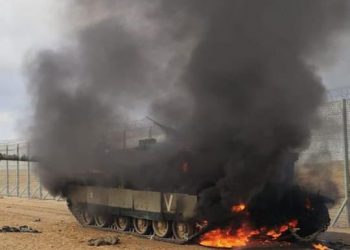
Thailand and Cambodia are engaged in their worst fighting in over a decade, exchanging heavy artillery fire across their disputed border, with at least 30 people killed and tens of thousands displaced.
Tensions began rising between the Southeast Asian neighbors in May, following the killing of a Cambodian soldier during a brief exchange of gunfire, and have steadily escalated since, triggering diplomatic spats and now, armed clashes.
WHERE DOES THE DISPUTE ORIGINATE?
A Cambodian Buddhist monk walks toward the Cambodia’s 11th century Hindu Preah Vihear temple, which was enlisted as UNESCO’s World Heritage site in Preah Vihear province, about 245km north of Phnom Penh, Cambodia on Feb. 8, 2011. 一名柬埔寨佛教僧侶2011年2月8日走向柬埔寨11世紀的印度教普里維希神廟。該神廟被列為聯合國教科文組織世界遺產,位於柬埔寨金邊以北約245公里的普里維希省。
Photo: AP 照片:美聯社
Thailand and Cambodia have for more than a century contested sovereignty at various undemarcated points along their 817km land border, which was first mapped by France in 1907 when Cambodia was its colony.
That map, which Thailand later contested, was based on an agreement that the border would be demarcated along the natural watershed line between the two countries.
In 2000, the two countries agreed to establish a Joint Boundary Commission to peacefully address overlapping claims, but little progress has been made towards settling disputes. Claims over ownership of historical sites have raised nationalist tension between the two countries, notably in 2003 when rioters torched the Thai embassy and Thai businesses in Phnom Penh over an alleged remark by a Thai celebrity questioning jurisdiction over Cambodia’s World Heritage-listed Angkor Wat temple.
A Cambodian soldier, right, and Thai soldier stand guard at the disputed ancient Khmer temple Prasat Ta Muen Thom, or Prasat Ta Moan Thom in Khmer, on the Cambodian-Thai border in Oddar Meanchey province on March 26. 3月26日,一名柬埔寨士兵(右)和一名泰國士兵在柬埔寨奧多棉吉省柬泰爭議邊界的古高棉大塔牟神廟站崗。
Photo: AFP 照片:法新社
WHAT WERE PREVIOUS FLASHPOINTS?
An 11th century Hindu temple called Preah Vihear, or Khao Phra Viharn in Thailand, has been at the heart of the dispute for decades, with both Bangkok and Phnom Penh claiming historical ownership.
The International Court of Justice awarded the temple to Cambodia in 1962, but Thailand has continued to lay claim to the surrounding land.
Cambodian supporters at a rally in central Melbourne, Australia on July 27, calling for an end to hostilities amid the ongoing conflict between Cambodia and Thailand. 柬埔寨支持者7月27日在澳洲墨爾本市中心集會,舉著標語牌,呼籲持續對立的柬埔寨及泰國結束敵對狀態。
Photo: AFP 照片:法新社
Tension escalated in 2008 after Cambodia attempted to list the Preah Vihear temple as a UNESCO World Heritage site, leading to skirmishes over several years and at least a dozen deaths, including during a weeklong exchange of artillery in 2011. Two years later, Cambodia sought interpretation of the 1962 verdict and the ICJ again ruled in its favor, saying the land around the temple was also part of Cambodia and ordering Thai troops to withdraw.
WHAT’S BEHIND RECENT TROUBLES?
Despite the historic rivalry, the current governments of Thailand and Cambodia enjoy warm ties, partly due to the close relationship between their influential former leaders, Thailand’s Thaksin Shinawatra and Cambodia’s Hun Sen.
Map of Cambodia and Thailand, showing the location of the Preah Vihear Temple, which both countries lay claim to. 柬埔寨與泰國之地圖,以及普里維希神廟之位置,兩國都聲稱對該神廟擁有主權。
Photo: Wikimedia Commons / Matthew Edwards 照片:維基共享資源 / Matthew Edwards
But nationalist sentiment has risen in Thailand after conservatives last year questioned the government’s plan to negotiate with Cambodia to jointly explore energy resources in undemarcated maritime areas, warning such a move could risk Thailand losing the island of Koh Kood in the Gulf of Thailand.
Tensions also rose in February when a group of Cambodians escorted by troops sang their national anthem at another ancient Hindu temple that both countries claim, Ta Moan Thom, before being stopped by Thai soldiers.
An effort by then Thai premier Paetongtarn Shinawatra, Thaksin’s daughter, to de-escalate the situation in a call last month with Hun Sen spectacularly backfired after a recording of the conversation was initially leaked and later released in full by the Cambodian leader. In the call, the 38-year-old prime minister appeared to criticize a Thai army commander and kowtow to Hun Sen, drawing public fury and a complaint from a group of senators, which led to her suspension by a court order on July 1.
People flee their homes near the Cambodia-Thailand border in Oddar Meanchey province, Cambodia on July 26. 7月26日,柬埔寨奧多棉吉省柬泰邊境附近的民眾逃離家園。
Photo: EPA 照片:歐新社
(Reuters)
泰國與柬埔寨爆發十多年來最激烈的衝突,在兩國邊界的爭議地區以重型火砲交火,目前已造成逾30人死亡,數萬人流離失所。
今年5月,一名柬埔寨士兵在短暫的交火中喪生,這兩個東南亞鄰國間的緊張局勢自此持續升高,引發了外交爭端,如今又演變成武裝衝突。
爭端之緣由
泰國與柬埔寨接壤處有817公里長,其中多處未定界之主權歸屬,一個多世紀以來爭議不斷。這條邊界最初是法國在1907年所繪製,當時柬埔寨為法國殖民地。
該地圖根據雙方協議,以自然分水嶺作為邊界,但泰方後來對這張地圖提出異議。
2000年,兩國同意成立聯合邊界委員會,以和平方式處理主權問題,但迄今進展有限。對古蹟的主權爭議也曾引發強烈民族情緒,尤其是在2003年,暴徒對泰國駐金邊大使館與泰國企業縱火,因為一位泰國名人據稱發表了言論,質疑柬埔寨對世界遺產吳哥窟的管轄權。
先前的衝突焦點為何?
爭議的核心,是一座建於11世紀的印度教神廟——柬埔寨稱為普里維希神廟(Preah Vihear),泰國則稱為考帕維漢神廟(Khao Phra Viharn)。數十年來,曼谷與金邊雙方均聲稱對該神廟擁有歷史主權。
國際法院(ICJ)1962年將該神廟判給柬埔寨,但泰國一直聲稱對周邊土地擁有主權。
2008年,柬埔寨試圖讓普里維希神廟列為聯合國教科文組織世界遺產,兩國緊張局勢升高,數年內爆發多次衝突,造成至少十餘人死亡,其中包括2011年持續一週的砲火攻擊。2013年,柬埔寨要求國際法院對1962年的裁決作進一步解釋,法院再次做出有利柬方的判決,裁定寺廟周邊土地亦屬柬埔寨,並命令泰軍撤離。
近期衝突的原因為何?
儘管泰國與柬埔寨有著歷史恩怨,但兩國的現任政府原本關係融洽,部分原因是兩位前領導人——泰國前總理戴克辛(Thaksin Shinawatra)與柬埔寨前總理洪森(Hun Sen)關係密切。
然而,近年泰國國內民族主義情緒升高。去年,保守派質疑政府計畫與柬埔寨談判共同開發尚未劃界的海域能源資源,警告此舉恐導致泰國失去泰國灣的閣骨島(Koh Kood,又譯沽島),引發輿論反彈。
今年2月,局勢進一步升高。當時一群由軍隊陪同的柬埔寨人,在另一座爭議印度教古廟——大塔牟神廟(Ta Moan Thom)高唱國歌,被泰國士兵制止,引發摩擦。
為緩解局勢,時任泰國總理、戴克辛之女貝東塔(Paetongtarn Shinawatra)上月曾致電洪森,試圖降溫,未料通話內容先是被外洩,後又被柬方完整公開,造成政治風暴。在通話中,38歲的貝東塔似乎批評了一位泰國軍方將領,並對洪森表現得過度恭敬,引發輿論譁然。一些參議員提出請願,最終導致她在7月1日被法院下令停職。
(台北時報林俐凱編譯)